

Wenn Frieden plötzlich nicht mehr selbstverständlich ist
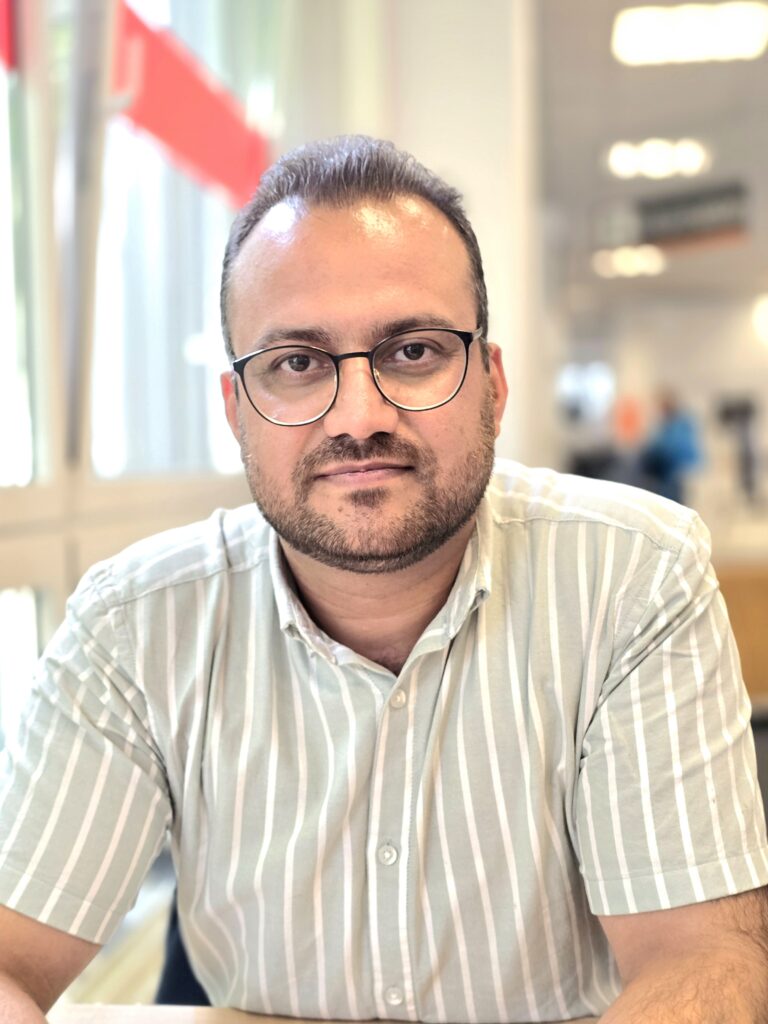
My name is Sayed Khalid Sadaat. I am 36 years old, and I have two children. I have been living with my family in Osnabrück since September 2021.
I completed my master’s degree in Journalism and Mass Communication, and since 2012 I have been working in the field of project management with various international organizations to support human rights activities.
I was a child of war, but today, I am a youth of peace.
I was born in 1989—the year the Soviet Union left Afghanistan and the civil war began. I was five years old when I first enrolled in school. I also remember another date very clearly: September 27, 1996. That was the day the Taliban executed Dr. Najibullah, the President of Afghanistan. As a child, I witnessed the dark days of war and instability in my country. Like many others, I never left. I stayed and hoped for change.
As a student during the Taliban regime, I had little understanding of the outside world. Our schools taught only religious texts, mostly centered around jihad. They influenced young minds to join the war. We had no new books—only torn pages. My older brother would copy notes onto scraps of paper from my friends’ books and give them to me. My mother even made notebooks from old paper bags. Despite the hardship, she always encouraged us to study hard.
In 2001, after the fall of the Taliban, I began to see the light. The dark memories felt like distant nightmares, and a new chapter filled with hope and opportunity began. A new government was formed with the support of the international community, and Afghanistan began its long journey of rebuilding. I am deeply grateful for the support we received. Over the last 20 years, Afghanistan made significant progress—in education, civil society, and infrastructure.
Unfortunately, recent political changes have reversed much of that progress. Today, the country faces growing uncertainty, with severe restrictions on education—especially for girls—and rising poverty. Yet, despite these challenges, the hope for a better future still lives on in the hearts of many Afghans.
Education is the backbone of any nation, and yet millions in Afghanistan are still deprived of this basic right. I am one of the few fortunate youths who completed primary school and had the chance to pursue higher education. Many others—especially girls—have been denied that opportunity due to political and social restrictions. In areas controlled by religious authorities, both boys and girls are often barred from continuing their studies. Poverty worsens the situation, forcing children to work and support their families. It’s heartbreaking to see them begging or working on the streets instead of attending school.
In 2014, I was invited to a peace and reconciliation seminar in Delhi, India, organized by an international organization. The experience was transformative and deepened my understanding of peacebuilding. After returning to Afghanistan, I began peace and reconciliation classes for school students and encouraged them to share what they learned with at least three friends or family members. Their enthusiasm gave me renewed hope for a peaceful and united Afghanistan.
In 2018, after completing my Master’s degree in India, I returned to Afghanistan with a deep commitment to promoting peace and expanding access to education. My mission was to empower underserved communities through knowledge and understanding.
I had the opportunity to work with several international organizations, supporting their missions while pursuing my own. My journey was never easy. I traveled to some of the most dangerous regions—areas under full Taliban control—to encourage both women and men to value peace and education. I remained hopeful for my country’s future. We worked hard to curb illegal migration by equipping young people with skills and knowledge, offering them a reason to stay. I especially valued my work with returnees from Pakistan, Iran, and Europe—helping them reintegrate, find hope, and rebuild their lives in Afghanistan.
I never thought of leaving my country. I was committed to staying and contributing to its progress.
But everything changed in August 2021. I had planned a short trip to India, unaware that I would never return. On August 15, the Taliban regained control of Afghanistan, and the country plunged into crisis. Thousands tried to flee. When I heard the news, I was in complete shock. It felt as though everything we had built over 20 years— with the support of the international community—had disappeared in a single day.
Stranded in a dark hotel room in Delhi, surviving on one meal a day, my mind was torn between my family—my two small children, just three and four years old—and the country I loved. I watched the news helplessly, heartbroken, as Afghanistan’s future unraveled.
For nearly a month, I lived in uncertainty. I didn’t know where to go or how to reunite with my family. With the help of Tdh, I was able to travel to Germany, holding onto the hope of seeing my loved ones again. When I arrived, I was still in shock. But I didn’t give up.
I immediately resumed my work with Terre des Hommes (Tdh), this time supporting Afghan refugees in crisis.
I will never forget those intense days—working more than 20 hours a day with my colleagues to help others find safety, stability, and hope.
Being a refugee is not easy. Even in a safe country, your heart is always with your homeland, with your family, and with those who continue to suffer. It is painful to know that you can’t help them in the ways you wish you could.
I chose to stay in Germany for the sake of my children. I don’t want them to grow up under the shadow of extremism. I want them to become compassionate, educated individuals—messengers of peace for the world.
I want to express my deepest gratitude to the people of Osnabruck. Your love, kindness, and support have made me feel safe and welcomed. Here, I have found peace—and I no longer feel like “the other.”